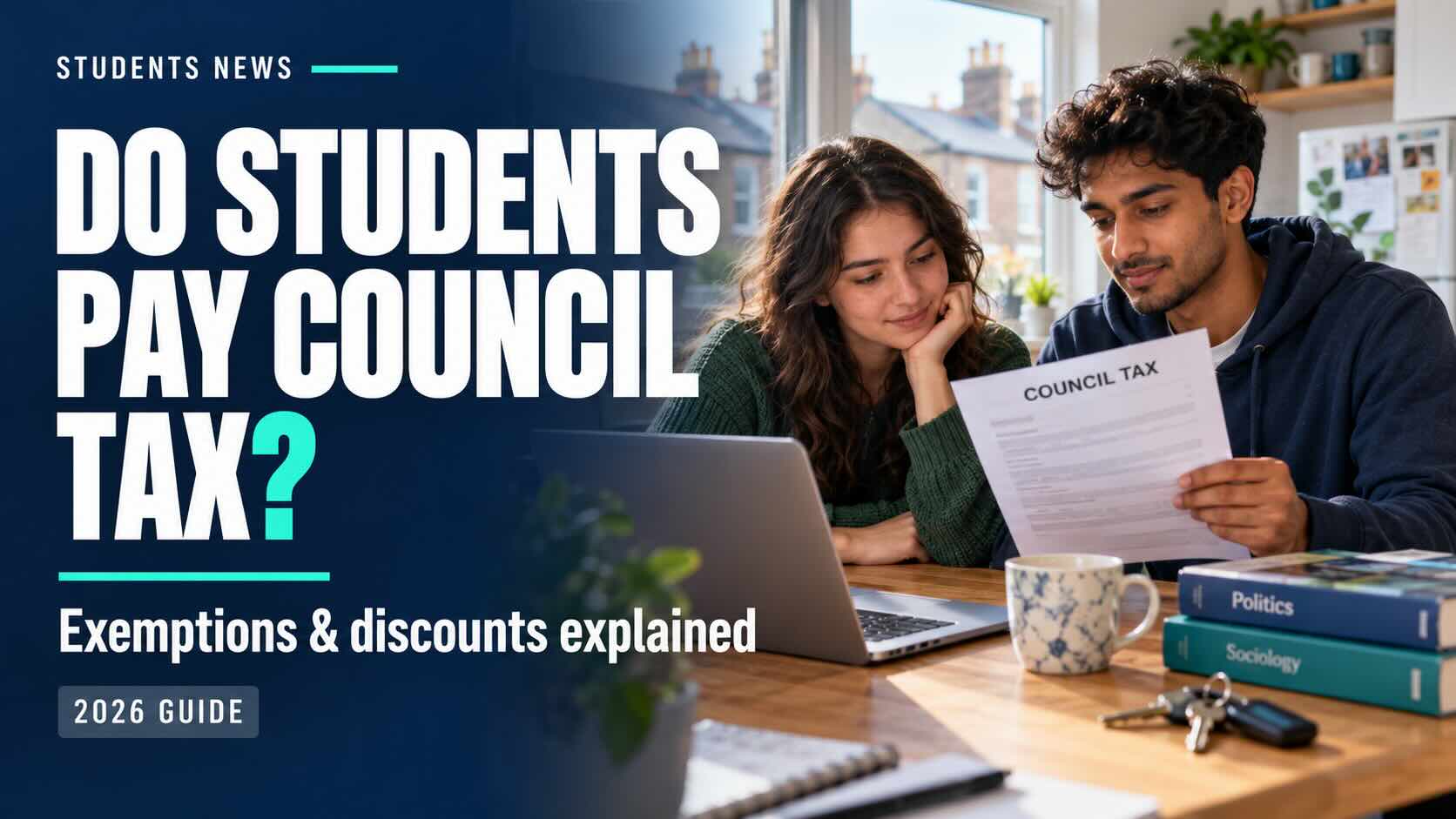
Do Students Pay Council Tax? Exemptions and Discounts Explained (2026)
Last updated: 30 September 2026
Short answer: if everyone in your home is a full-time student, you don’t pay council tax. If you share with people who aren’t students, the household gets a bill, but it may qualify for a 25% or 50% discount. None of this happens automatically, so you usually have to tell your council. This guide covers England and Wales. Scotland and Northern Ireland handle things a little differently, so check your local council.
Who counts as a full-time student for council tax?
According to GOV.UK, you count as a full-time student if your course:
- lasts at least 1 year, and
- involves at least 21 hours of study per week.
If you are under 20 and studying for a qualification up to A level, your course must last at least 3 months and involve at least 12 hours a week.
Part-time students usually don’t count, so they may have to pay.
The three most common situations
| Who lives in the property | What you pay |
|---|---|
| Everyone is a full-time student | Nothing. The property is exempt |
| Students plus one non-student adult | Bill with a 25% discount (the non-student is treated as living alone) |
| Students plus two or more non-student adults | Full bill (no student discount) |
This works because full-time students are “disregarded” when the council counts the adults in a home.
Who else is “disregarded”?
Several other groups don’t count either, which can increase a household’s discount. They include:
- student nurses
- apprentices (with a declaration from your employer)
- 18 and 19-year-olds in full-time education
- under-25s receiving Education and Skills Funding Agency support
- foreign language assistants registered with the British Council
If everyone in the home is disregarded but they don’t all qualify for the student exemption, the bill is reduced by 50%.
Real-life examples
- Four full-time undergraduates share a house: the property is exempt. Each student sends the council their exemption certificate.
- Three full-time students and one friend who works full-time: the working friend is treated as living alone, so the household gets a bill with a 25% discount. The students aren’t legally required to pay it, but in practice housemates often agree how to split it, so discuss this before signing the tenancy.
- A full-time master’s student living with a working partner: the partner is treated as living alone, so the household gets a bill with a 25% discount.
- A student who drops to part-time halfway through the year: from that date the student is no longer disregarded, so the council may send a bill. Tell the council straight away.
What about halls of residence?
Student halls are normally exempt from council tax, so students living in halls don’t receive a bill. If you get one, contact your university accommodation office and your council.
How to claim your student exemption
- Get a council tax exemption certificate (sometimes called a student status letter) from your university. Many universities let you download it from the student portal.
- Contact your local council. Most have an online form for student exemptions. Search for “[your council name] council tax student exemption”.
- Send the certificate for every student in the property, with names and course dates.
- Keep copies and check the next bill shows the exemption or discount.
Tip: do this as soon as you move in. Councils can send bills in the first few weeks, and it’s easier to sort out before arrears build up.
Scotland and Northern Ireland
- Scotland: council tax also applies, and properties where everyone is a full-time student are generally exempt. Apply through your local council with proof of your student status.
- Northern Ireland: there’s no council tax. Homes pay domestic rates instead, which have their own rules. Many student tenancies include rates in the rent, so check your contract.
Whose name should be on the bill?
If the property isn’t exempt, the person responsible for paying is usually the adult resident with the strongest legal interest, normally the tenants named on the tenancy agreement. In some shared houses (houses in multiple occupation, or HMOs), the landlord is responsible instead, and the cost may be included in your rent. Ask your landlord or letting agent before you sign.
Common mistakes to avoid
- Ignoring a bill because “students don’t pay”. If you do nothing, the council may take enforcement action. Reply and send your certificate.
- Summer gaps. Between the end of one course and the start of another, or after graduation, you may no longer count as a student. Check the dates on your tenancy.
- Dropping to part-time. Tell the council if your status changes. Claiming a discount you’re not entitled to can mean repaying it plus a fine.
Frequently asked questions
Do international students pay council tax?
Full-time international students get the same exemption as UK students. A spouse or dependant who isn’t a student may affect the bill, so contact your council.
Do students pay council tax in their final summer?
Usually you stop counting as a student once your course ends, so a bill may start from that date if you stay in the property.
Do postgraduate students pay council tax?
Full-time postgraduate students (for example on a full-time master’s or PhD) generally count as students if they meet the course criteria above.
Sources: GOV.UK – Council Tax discounts for full-time students; GOV.UK – who has to pay Council Tax. This article is general information. Your local council makes the final decision.