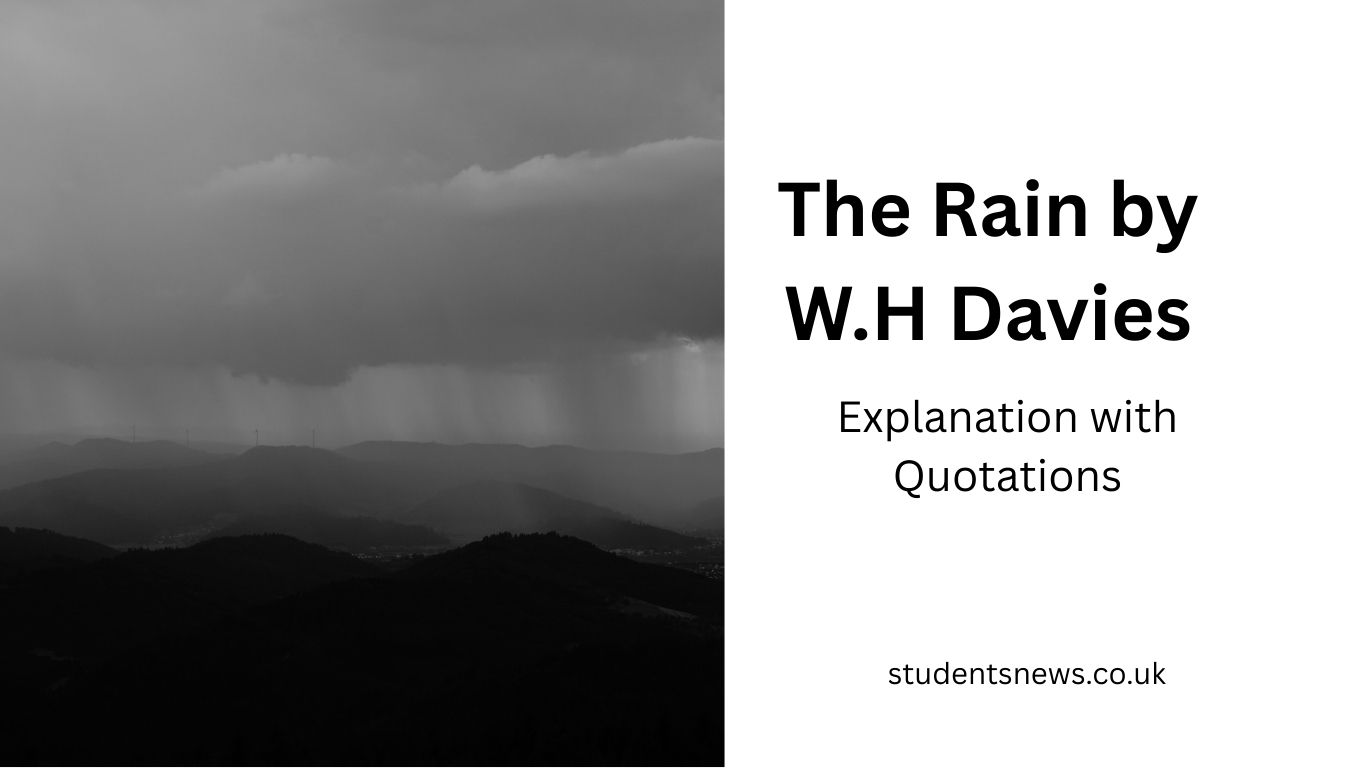
The Rain by W.H. Davies: Summary with Quotations for 10th Class
“The Rain” is a short nature poem by the Welsh poet W.H. Davies. In this post you will find the rain summary with quotations for 10th class, along with the central idea, a simple explanation, word meanings and important questions.
Quotations for the Poem The Rain
- “The best thing one can do when it’s raining is to let it rain.”
— Henry Wadsworth Longfellow - “Do not be angry with the rain; it simply does not know how to fall upwards.”
— Vladimir Nabokov - “A rain of tears is not a sign of weakness, it is a sign of strength.”
— Unknown - “Raindrops are nature’s tears of joy.”
— Terri Guillemets - “The day which we fear as our last is but the birthday of eternity.”
— Lucius Annaeus Seneca - “The earth has music for those who listen.”
— George Santayana
The Rain Summary with Quotations (200 Words)
Word Count: 200 words
In the poem, the speaker listens to the sound of rain falling on the leaves. They describe how the leaves on the top of the tree are able to catch more rain and then drop it onto the leaves below. The speaker finds this sound pleasant and soothing, calling it a “sweet noise.” The rain creates a sense of peace as it nourishes the leaves, with the top leaves providing for the poorer ones beneath.
“The rain falls on the just and the unjust.”
— The Bible (Matthew 5:45)
The poem continues with the speaker imagining what will happen when the rain stops. They hope that when the sun comes out, each raindrop will sparkle and shine brightly. The speaker is filled with anticipation, looking forward to the sight of the sun shining on the rain-soaked world, which will make everything look beautiful and bright.
“Raindrops are the lullaby of nature.”
— Terri Guillemets
The poem reflects the relationship between rain and sunlight, showing how the rain brings life and beauty to nature. It highlights the cycle of rain and sun, which brings both nourishment and brightness, making the world more alive and full of wonder.
“Nature always wears the colors of the spirit.”
— Ralph Waldo Emerson
Standard Summary (150 words)
In the poem, the speaker describes the sound of rain falling on the leaves. The leaves at the top of the tree catch the rain and drop it onto the ones below, creating a gentle, soothing sound. The speaker finds this noise pleasant, as it symbolizes how the rain nurtures the plants.
“The rain falls on the just and the unjust.”
— William Cecil Duncan
The speaker then imagines what will happen once the rain stops. They hope that when the sun shines, each raindrop will sparkle, creating a beautiful sight. This moment is filled with optimism and anticipation.
“Raindrops are the lullaby of nature.”
— Terri Guillemets
The poem reflects the relationship between rain and sunlight, showing how they work together to bring life and beauty to the earth. It emphasizes the cycle of nature and how it renews and nourishes the world.
“Nature always wears the colors of the spirit.”
— Ralph Waldo Emerson
The Rain by W.H. Davies
I hear leaves drinking rain;
I hear rich leaves on top
Giving the poor beneath
Drop after drop;
‘Tis a sweet noise to hear
These green leaves drinking near.
And when the sun comes out,
After this rain shall stop,
A Wondrous light will fill
Each dark, round drop;
I hope the Sun shines bright;
It will be a lovely sight.
About the Poet: W.H. Davies
William Henry Davies (1871–1940) was a Welsh poet and writer. He spent many years travelling as a tramp in Britain and America, and wrote about it in The Autobiography of a Super-Tramp (1908). His poems are simple, musical and full of love for nature. His most famous poem is “Leisure”, which begins: “What is this life if, full of care, / We have no time to stand and stare.”
Central Idea of the Poem The Rain
The poem shows how nature shares its blessings. The leaves at the top of the tree drink the rain first and then pass drops down to the leaves below. In the same way, the rich should share their wealth with the poor. The poet also looks forward to the beauty that will come when the sun shines on the wet leaves.
Explanation of The Rain
The poet hears the sound of rain falling on the leaves, as if the leaves are drinking it. The rich leaves at the top of the tree drink first, then let drops fall to the poor leaves underneath. It is a sweet sound for the poet to hear the green leaves drinking so close to him.
Then the poet imagines the scene after the rain stops. When the sun comes out, a wonderful light will fill every dark, round raindrop on the leaves, and each drop will shine like a jewel. The poet hopes that the sun will shine brightly, because it will be a lovely sight.
Themes of the Poem
- Beauty of nature: the rain, leaves and sunlight create a peaceful, beautiful picture.
- Sharing and generosity: the rich leaves give to the poor leaves, a lesson for human society.
- Hope: after the rain comes bright sunshine, just as good days follow hard ones.
Word Meanings
- Rich leaves on top: leaves at the top of the tree that get rain first (a symbol of the wealthy)
- Poor beneath: lower leaves that get less rain (a symbol of the poor)
- Wondrous: wonderful, amazing
- ‘Tis: it is
- ‘Twill: it will
Important Questions and Answers
What does the poet hear in the poem?
He hears the leaves drinking rain, and the upper leaves passing raindrops down to the lower leaves.
What lesson does the poem teach?
It teaches that the rich should share their wealth with the poor, just as the upper leaves share rain with the leaves below.
What will happen when the sun comes out?
A wonderful light will fill every raindrop on the leaves, and the whole tree will sparkle. It will be a lovely sight.
Frequently Asked Questions
How many quotations should I use in The Rain summary?
Two or three quotations are enough for the 10th class exam: one at the beginning, one in the middle and one at the end.
Can I download The Rain summary with quotations as a PDF?
Yes. Press Ctrl + P on this page (or Print/Share on your phone) and choose Save as PDF.
Also read: Daffodils Summary with Quotations and Summary of the Poem Peace. Learn more about the poet on Poetry Foundation.