Student Loan Repayment Thresholds 2026/27: How Much You Repay on Each Plan
If you have a student loan from England, Wales, Scotland or Northern Ireland, you only start repaying once your income is above a set threshold, and you then pay a fixed percentage of the amount you earn above it. The thresholds change most years. This guide sets out the figures for the 2026/27 tax year (6 April 2026 to 5 April 2027), shows what that means in pounds, and explains how to check which plan you are on.
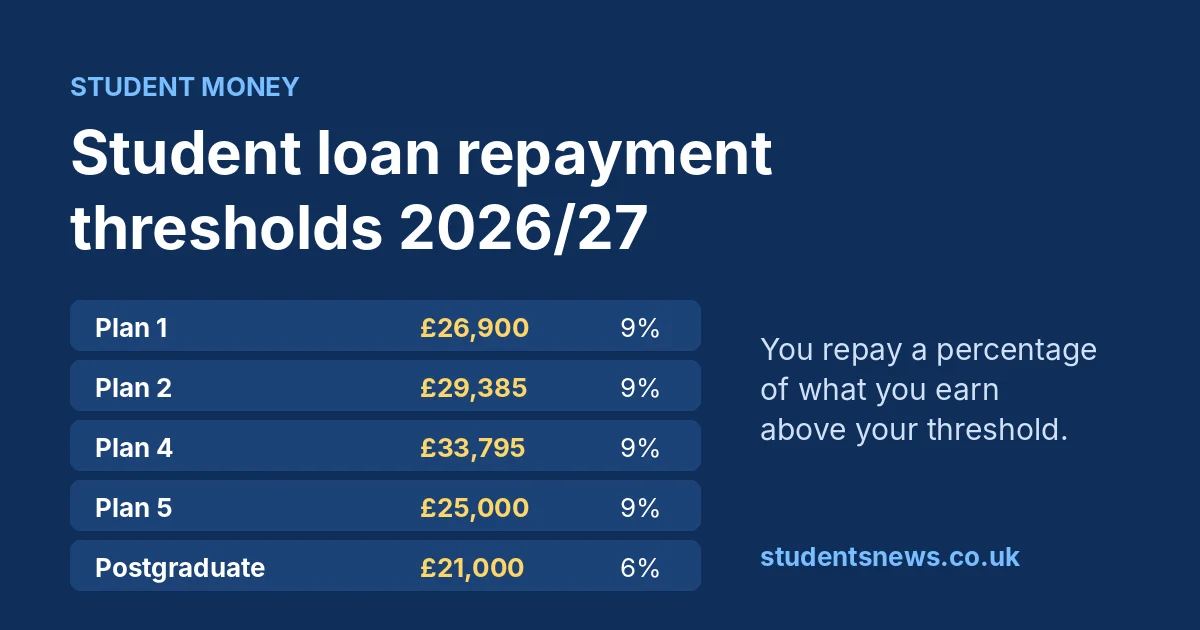
Student loan repayment thresholds for 2026/27
| Plan | Yearly | Monthly | Weekly | You repay |
|---|---|---|---|---|
| Plan 1 | £26,900 | £2,241 | £517 | 9% above the threshold |
| Plan 2 | £29,385 | £2,448 | £565 | 9% above the threshold |
| Plan 4 | £33,795 | £2,816 | £649 | 9% above the threshold |
| Plan 5 | £25,000 | £2,083 | £480 | 9% above the threshold |
| Postgraduate Loan | £21,000 | £1,750 | £403 | 6% above the threshold |
Compared with 2025/26, the Plan 1 threshold rose by £835 (from £26,065), Plan 2 by £915 (from £28,470) and Plan 4 by £1,050 (from £32,745). The Postgraduate Loan threshold stayed at £21,000. Plan 5 is new: the first Plan 5 repayments are due from April 2026.
Which repayment plan are you on?
You cannot choose your plan. It depends on where you applied for student finance and when your course started:
- Student Finance England: courses that started on or after 1 August 2023 are on Plan 5; courses that started between 1 September 2012 and 31 July 2023 are on Plan 2; courses that started before 1 September 2012 are on Plan 1.
- Student Finance Wales: courses that started on or after 1 September 2012 are on Plan 2; earlier courses are on Plan 1.
- Student Awards Agency Scotland (SAAS): Plan 4.
- Student Finance Northern Ireland: Plan 1.
- Master’s and doctoral loans from England or Wales are on the Postgraduate Loan plan.
If you are not sure, sign in to your Student Loans Company online account and download your repayment plan letter. If you have more than one type of loan, you can be on more than one plan.
How much will you actually repay?
Repayments are worked out on income above the threshold, not on what you owe. Here are some examples using the 2026/27 figures (rounded to the nearest penny; your payslip may differ by a few pence):
- Plan 2, earning £35,000 a year: £35,000 − £29,385 = £5,615. 9% of that is about £505 a year, or around £42 a month.
- Plan 5, earning £30,000 a year: £30,000 − £25,000 = £5,000. 9% of that is £450 a year, or around £37.50 a month.
- Postgraduate Loan, earning £30,000 a year: £30,000 − £21,000 = £9,000. 6% of that is £540 a year, or £45 a month.
If you earn below your threshold, you repay nothing that month. Interest is still added to the balance, though.
When do repayments start?
The earliest you start repaying is the April after you leave your course, whether you graduate or drop out. If you are employed, your employer takes repayments through PAYE, alongside tax and National Insurance, and you will see them on your payslip. If you are self-employed or file a Self Assessment return, HMRC works out what you owe from your total income for the year.
Repayments are based on each job separately if you have more than one employer, so two small part-time jobs below the threshold will not trigger repayments even if their combined pay is above it. Self Assessment works differently and uses your combined annual income.
If you have more than one plan
If you have, say, both a Plan 1 and a Plan 2 loan, you repay 9% of income above the lowest threshold of your plans, in one payment that is split between them. If you also have a Postgraduate Loan, you pay 6% above £21,000 on top of that, so the two deductions run at the same time.
Interest rates
GOV.UK currently lists interest of 4.1% for Plans 1, 4 and 5, and 6% for the Postgraduate Loan. Plan 2 interest depends on income after you leave your course: 4.1% up to £29,385, rising gradually to 6% for income of £52,885 or more. Interest rates can change during the year, so check GOV.UK for the latest figures.
When is a student loan written off?
- Plan 1: 25 years after the April you were first due to repay (or at age 65 for loans first paid before 1 September 2006).
- Plan 2: 30 years after the April you were first due to repay.
- Plan 4: 30 years after the April you were first due to repay (different rules apply to older loans).
- Plan 5: 40 years after the April you were first due to repay.
- Postgraduate Loan (England or Wales): 30 years after the April you were first due to repay.
Can you get money back?
Yes. If your income for the whole tax year ends up below your threshold but repayments were taken, for example because you earned more in a few months than in the rest of the year, you can ask the Student Loans Company for a refund after the tax year ends. It is also worth checking your account if you have finished repaying, so that deductions stop on time.
More UK student guides
- Student finance payment dates 2026/27
- Do students pay council tax?
- Best student bank accounts 2026
- UCAS deadlines for 2027 entry
Sources: GOV.UK – What you pay; GOV.UK – Which repayment plan you are on; GOV.UK – When you start repaying; GOV.UK – When your loan is written off. Figures checked on 22 October 2026.