

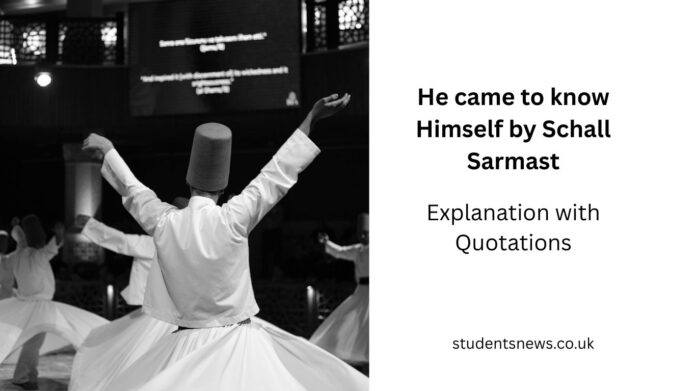
“He Came to Know Himself” is a spiritual poem by Sachal Sarmast. The poem highlights the Sufi belief that true wisdom comes from self-realization. It conveys that by knowing oneself, a person can discover the Divine truth within and achieve spiritual enlightenment. In this article, we will discuss the explanation of He came to know himself with Quotations. Hope it is easy to understand.
Quotes of the poem He came to know himself by Sachal Sarmast
Here are more quotes related to the poem “He Came to Know Himself” by Sachal Sarmast (author name included):
-
“He who knows himself knows his Creator.” — Sachal Sarmast
-
“Within your own heart lies the hidden treasure.” — Sachal Sarmast
-
“Break the chains of ego to see the light of truth.” — Sachal Sarmast
-
“The path to God begins from within.” — Sachal Sarmast
-
“When the self disappears, only the Divine remains.” — Sachal Sarmast
-
“Do not wander outside; the Beloved dwells in you.” — Sachal Sarmast
-
“Self-realization is the key to eternal peace.” — Sachal Sarmast
-
“The one who finds himself finds everything.” — Sachal Sarmast
-
“Lift the veil from your heart and see the Truth.” — Sachal Sarmast
-
“True wisdom begins with knowing your own reality.” — Sachal Sarmast
If you want to read more poems, check out our Poem Pages where we have listed explanations of the poems.
Explanation of the poem
Line 1 to 4
These lines explain that the person’s only aim in life was to truly know himself. He was not interested in worldly pleasures, wealth, or fame, and nothing else captured his attention. To achieve this deep self-realization, he had to embark on a spiritual journey, removing all pride, ego, and distractions from his heart. In this process, he became completely enmeshed in Divine love, because Sufi philosophy teaches that love is the path to discovering God. Through this love, he could see beyond the illusions of the world and understand the eternal truth that resides within. The poet emphasizes that knowing oneself is not just an intellectual act but a transformative experience that connects the seeker to the Divine.
“He who knows himself knows his Creator.” — Sachal Sarmast
This shows that self-knowledge combined with sincere love of God leads to spiritual enlightenment, inner peace, and ultimate truth.
Line 4 to 8
These lines describe the ultimate sacrifice of love and devotion. The poet compares the seeker to someone who descends from the highest spiritual realm (“alighted from high heaven”) to pour unconditional love into the world. The reference to Mansur symbolizes a Sufi saint who faced death rather than abandon his truth, showing that true love for the Divine may demand complete selflessness—even to the point of suffering or martyrdom. The lines emphasize that spiritual enlightenment is not just about inner realization but also about courage, devotion, and readiness to give everything for love of God.
“When the self disappears, only the Divine remains.” — Sachal Sarmast
This illustrates that in total surrender and love, the ego is destroyed, and only the presence of the Divine is experienced.
Line 8 to 12
The verse reflects on a figure who endured extreme hardship and humiliation, wandering the “bazaars of Egypt” only to be sold as a slave, symbolizing the trials, oppression, and undervaluation one may face in life. “Sachu” acts as a wise narrator who speaks the bare truth, recounting this sojourn on earth without embellishment, highlighting the temporary nature of life and the lessons hidden within suffering. This echoes the idea of “akthy ko kana”—a small but profound truth about resilience, humility, and spiritual insight. As Nelson Mandela said,
“The greatest glory in living lies not in never falling, but in rising every time we fall,”
reminding us that enduring hardship and recognizing truth in struggle is itself a form of wisdom.
He came to know himself by Sachal Sarmast
He came to know Himself
Naught else had He in view
To be able to realize this
He got enmeshed in love
He alighted from high heaven
To pour a cascade of love
Became Mansur to mount the gallows
Just to have His head cut off.
He treaded the bazaars of Egypt
Just to be sold for a slave
Sachu speaks the bare Truth
To speak of His sojourn on earth.

